






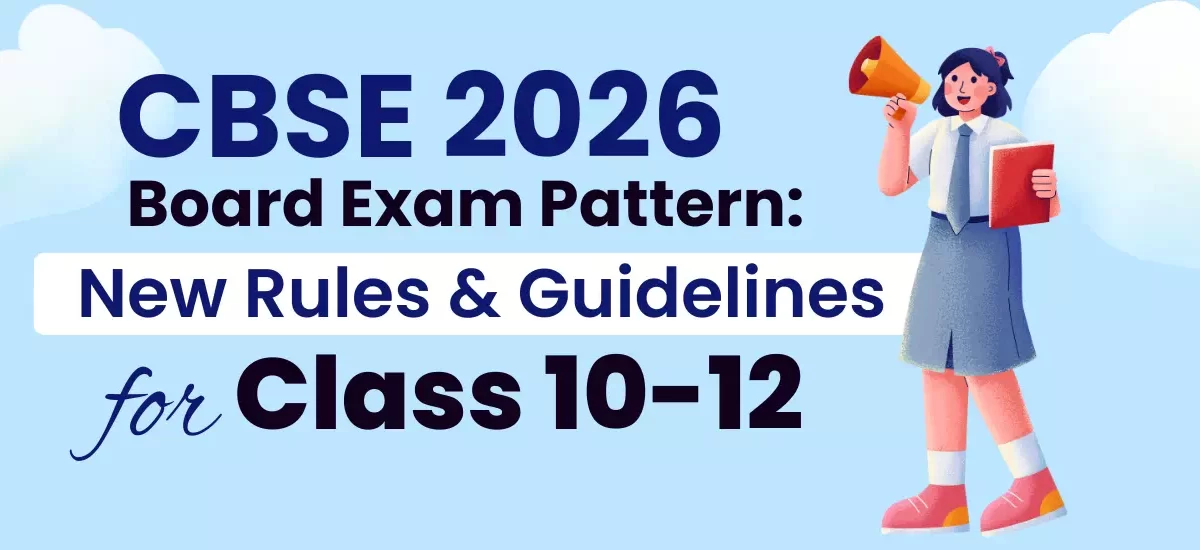
Are you still relying on last year’s board exam pattern for Class 10 and 12? If yes, you need to update your knowledge right away. The CBSE 2026 board exam changes bring new rules, a revised paper structure and a completely new grading approach. This directly impacts how students prepare for boards.
The CBSE exam guidelines 2026 emphasise that now the examinations will not only decide the scores but also influence future academic choices. The Central Board of Secondary Education has redesigned the board exam framework to focus more on understanding than memorisation. It highlights the importance of stress management, attendance and internal assessments.
Whether you are a student preparing for Class 10 or 12 board exams or a parent guiding your child in the right direction, understanding the updated CBSE exam pattern 2026 is essential. So, read this blog carefully to know all about the recent changes and prepare smarter for the boards ahead.
Major CBSE Guidelines for Board Exam 2026
CBSE has released comprehensive guidelines for board exams in 2026. These guidelines clearly explain how the board exams will be conducted. They are designed to ensure discipline, fairness and uniform evaluation across schools. To avoid any last-minute confusion, read the guidelines given below.
New Structure of Science and Social Science Question Papers
One of the most important CBSE new rules for Class 10 2026 is the section-wise structure of Science and Social Science papers.
The Science paper will now be divided into the following three compulsory sections.
| Section | Subject |
| A | Biology |
| B | Chemistry |
| C | Physics |
The Social Science paper will be divided into four compulsory sections as follows.
| Section | Subject |
| A | History |
| B | Geography |
| C | Political Science |
| D | Economics |
Students must write answers in the correct section of the answer sheet. If an answer for a question is written in the wrong section, it will not be evaluated and marked as “Attempt Not Done.” Students must go through and attempt the sample question papers released by CBSE for better understanding.
Two Board Exams in a Year for Class 10
Another of the significant CBSE guidelines for Class 10 is that from 2026 onwards, two board exams will be conducted for Class 10 in a single academic year.
- The first one will be conducted in February, and it is mandatory to appear for these exams. Practical exams will also be conducted in February.
- The next board examination will be conducted in May. These are optional. Only students who pass on the first attempt can appear and reattempt up to three subjects. These exams are for improvement, and the best marks out of the February and May exams will be considered in the final result.
75% Attendance Mandatory for Class 9 and 10
The CBSE board rules and regulations 2026 also make it compulsory to maintain a minimum 75% attendance for Class 9 and 10 students. Students who fail to maintain this will not be permitted to appear in the board examinations.
Also Read: Best Exam Preparation Tips for Students in Boarding Schools in Dehradun
CBSE New 9-Point Grading System
CBSE 2026 board exam changes implement a new 9-point grading system. It replaces the earlier evaluation method. This system ensures greater clarity, transparency and fairness.
| Marks Range | Grade | Grade Points | Result |
| 91 – 100 | A1 | 10.0 | Pass |
| 81 – 90 | A2 | 9.0 | Pass |
| 71 – 80 | B1 | 8.0 | Pass |
| 61 – 70 | B2 | 7.0 | Pass |
| 51 – 60 | C1 | 6.0 | Pass |
| 41 – 50 | C2 | 5.0 | Pass |
| 33 – 40 | D | 4.0 | Pass |
| 21 – 32 | E1 | 0.0 | Fail |
| 0 – 20 | E2 | 0.0 | Fail |
New Paper Pattern for Board Exam 2026
The new pattern of board exam 2026 promotes conceptual learning and real-life application. It ensures students are tested not just based on memorisation but on understanding, application and analysis. This new paper design involves the following types of questions.
| Type of Questions | Weightage |
| Competency-based, case-based, source-based, data interpretation, situational problems | 50% |
| Objective Questions (MCQs) | 20% |
| Short & Long Answer Questions | 30% |
The new CBSE 2026 board exam pattern makes 50% of the paper competency based and situational questions. This encourages students to think beyond textbooks and apply concepts to real-life scenarios. Top schools appreciate this change as it exposes students to future-ready learning. Initiatives such as the University Career Fair 2025 also aim for the same. It helps students understand how classroom learning connects to university programs, skill requirements, and long-term career pathways. This is why top schools like the TonsBridge School participated in it.
Internal Assessment
The CBSE new rules for Class 12 2026 and Class 10 make internal assessment compulsory for all students.
| Particular | Details |
| Internal Assessment | Mandatory |
| Missing Assessment | Result will not be declared |
| Classes Covered | Class 10 and Class 12 |
| Assessment Period | 1 January to 14 February 2026 |
| Total Marks | 100 per subject |
| Components | Theory, Practical, Project, Internal Assessment |
Provisional Admission in Class 11
As of this year, two board exams will be conducted for Class 10; CBSE has made sure students do not lose an academic year. For this, provisional admission will be provided in Class 11 based on February exam results for students who appear for the improvement board exam in May. Admission will be finalised after the final result declaration.
CBSE Practical Exam SOPs
To ensure uniformity and transparency, CBSE has issued clear SOPs for practical exams, projects, and internal assessments. These are as follows.
- Practical exams to be conducted from 1 January to 14 February 2026
- Marks for practicals to be uploaded on the same day
- Internal teachers will assess practical exams for Class 10 students
- External examiners will be appointed for Class 12 practical exams
CBSE Exam Day Guidelines and Tips
Exam day instructions are also updated by the CBSE, and every student must follow them.
- Entry not allowed after 10:00 AM
- Reach the centre at least 30 minutes early
- Wear school uniform
- Carry the CBSE admit card and school ID
- Follow the instructions on the admit card
- No student is allowed to leave before the exam ends
- Maintain discipline at all times
Final Words
The CBSE 2026 board exam changes clearly reflect CBSE’s effort to make board examinations less stressful for the students. These guidelines ensure that the exams are no longer about merely memorising textbooks, but they now focus on conceptual understanding, smart exam strategies, regular attendance and internal assessments. Being aware of the CBSE new rules can make a huge difference in confidence and performance.
Parents and schools play a crucial role in ensuring discipline, consistency and the right academic support at home. Schools that stay aligned with the regularly evolving framework of CBSE help students adapt smoothly to the changing guidelines. One such institution is the TonsBridge School, Dehradun. It focuses on structured learning, exam readiness and continuous assessment. As a result, it helps students stay informed, prepared and supported.
FAQs
Will CBSE conduct two board exams for Class 12 from 2026 onwards?
No, two board exams in a single academic year will be conducted only for Class 10 students. The exam frequency remains once per academic session for Class 12 students.
Are competency-based questions more complex than traditional questions?
Competency-based questions are not necessarily more difficult than traditional questions. They aim to test application, understanding and analytical skills. They are manageable for students who focus on real-life examples, concepts and regular practice.
What happens if a student misses an internal assessment due to a medical emergency?
Although CBSE has now strictly made internal assessment mandatory for all students, schools may follow CBSE guidelines for approval and documentation in case of medical emergencies. Missing internal assessments without a valid reason will result in withholding.
How does the new 9-point grading system reduce exam pressure on students?
The 9-point grading system is designed for a clearer and fairer evaluation of students’ performance. Grading helps reduce extreme score-based comparisons, reducing pressure on students. It focuses on the overall performance of a student.
How should parents help students under the new CBSE exam system?
Parents can help students by making them aware of the new rules as guided by the school. Also, they can monitor attendance, support concept-based learning, encourage consistent study habits, and ensure the timely completion of internal assessments and projects.