






Educational technology means different things to different people. For some, it can be walking children to the end of the corridor to visit the computer lab. There, kids might learn how to create a spreadsheet or type an assignment that could have been handwritten. At The TonsBridge Residential and Day School, Dehradun, students experience technology integration from Nursery through to Class XII. It is not an afterthought or something supplementary to the curriculum. It is helping to redefine the complete teaching and learning cycle, including how students are assessed, how learners are introduced to scientific concepts, how students create, and most importantly, how they are taught to collaborate and communicate with each other.
- Why Technology Integration Cannot Be Superficial Anymore
- Smart Classrooms: Where Every Lesson is Brought to Life
- Coding and Computational Thinking Starting From Primary School
- Digital Citizenship: The Skill That Ties Everything Together
- What Makes The TonsBridge Stand Out?
- The Beginning of a New Era
Why Technology Integration Cannot Be Superficial Anymore
This is the issue that the National Education Policy 2020 is trying to resolve. NEP 2020, unapologetically, supports educational technology at each and every level, not just secondary school, and not just a standalone computer science class. NEP 2020 mandates that schools incorporate digital literacy, computational thinking, and technology-integrated learning by doing. These are the essential, foundational skills that all other learning is built around. They are the basics.
The National Curriculum Framework for School Education 2023 goes on to state that schools should use technology to promote inquiry-based learning, creative expression, and real-world problem-solving, and that technology should not be used merely to transmit teaching in the form of recorded videos.
As 2026 approaches, many parents across India wonder about the role of technology in the classroom. Most schools make use of some type of technology. But the more important consideration is whether the technology is reinventing classroom learning, or whether it has simply been layered on top of outdated methodologies.
Smart Classrooms: Where Every Lesson is Brought to Life
If the classroom is the brain of the school, then the dining hall is definitely its heart. We are miles away from the outdated tradition of “hostel food.” At The TonsBridge School, we treat the experience with the same rigor that we treat our physics curriculum. It is an accepted fact that a student’s mind is inescapably associated with their tongue.
The menu is a carefully charted course in terms of nutrition and flavor. We think that Sunday roasts or the rightly seasoned regional dishes have been able to do much more than simply satisfy the stomach, for they have been able to provide the crucial function of giving children that feeling of belonging. When the nutritional values are the best, the performance in the playing field as well as in the exam room is also the best.
Smart Classrooms: Where Every Lesson is Brought to Life
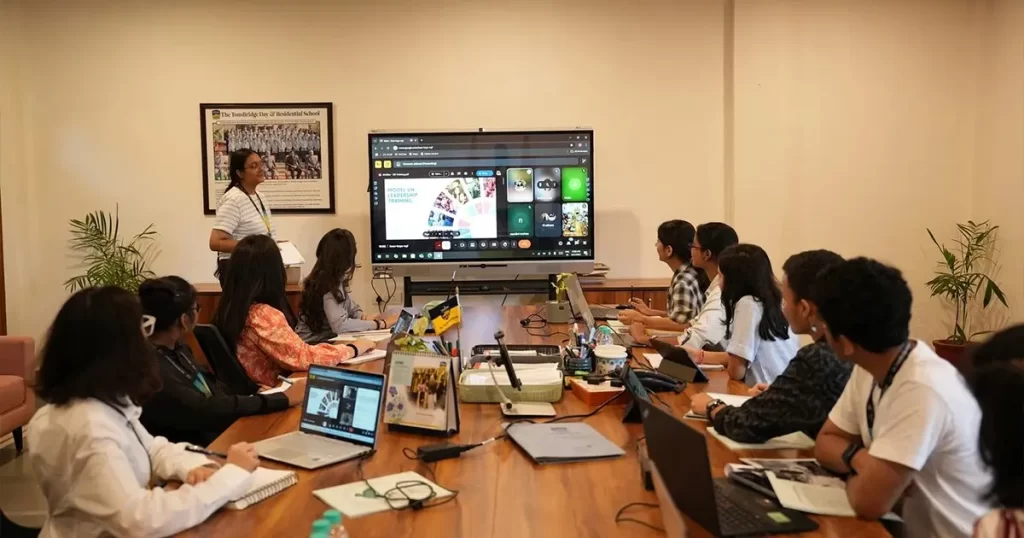
The reinvention of the learning experience at The TonsBridge starts in the Smart Classrooms. Each classroom has interactive digital boards, audio-visual aids, and real-time learning tools to help teachers step away from the blackboard and deliver something far more engaging.
When learning about how tectonic plates move, for example, students do not just read about how the plates shift and collide, and mountains form. They watch a simulation of those processes unfolding over millions of years. Learning about the human circulatory system is not about memorising a diagram; it is about using an interactive 3D model of the heart to trace blood flow in real time and study the effects of different conditions on cardiac function.
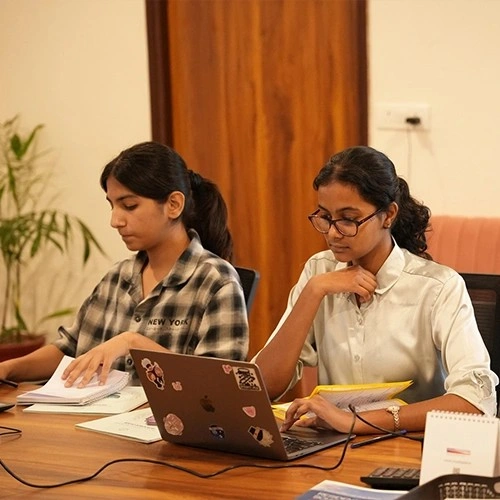
Educational and cognitive researchers have shown that learners remember more when they are exposed to information in multiple ways, not just through reading and repetition. The design of The TonsBridge smart classrooms reflects this research, not for the purpose of recruiting students, but as a part of everyday classroom teaching.
Coding and Computational Thinking Starting From Primary School
Coding learning activities begin in Primary School at The TonsBridge. While Primary School students are not formally taught programming syntax, they begin building their understanding of logic, sequencing, and problem-solving through robotics kits, gamified logic challenges, and block-based programming environments.
Students in Middle School are taught structured programming, application development, and introductory data management. In Senior School, students learn Python, introductory concepts of artificial intelligence, and participate in data science mini-projects. Students also take part in tech competitions and hackathons to help apply theory to practice.
Learning to code is about much more than programming. Coding and app development assist students in developing empathy and user-centred problem-solving. The skills and knowledge gained are applicable to many disciplines outside of computer science.
Digital Citizenship: The Skill That Ties Everything Together
Learning about technology alone, without responsibility, is simply exposure. At The TonsBridge, digital citizenship is integrated into the technology curriculum from the beginning; it is not an afterthought.
Students learn how to stay safe online, how to secure their personal information, how to use social media responsibly, how to spot misinformation, and the ethics of AI. In an age of deep fakes, algorithmic bias, and AI-generated content, schools that educate their students about the digital world prepare them remarkably well for the future.
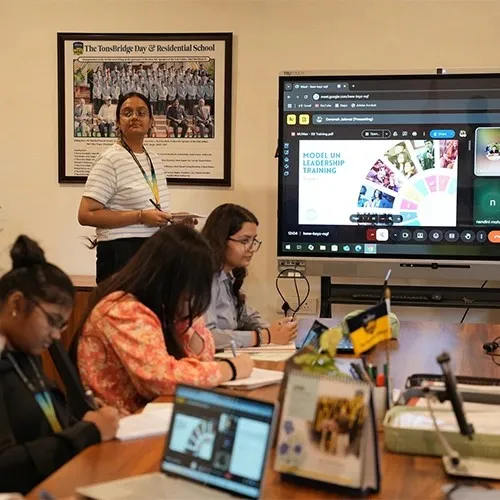
The greater freedom that comes with boarding school and the absence of constant parental supervision mean responsible digital citizenship becomes all the more critical. The TonsBridge ethos encourages all students to embrace the responsible use of technology, giving them the self-belief and the ability to use it with purpose and wisdom.
What Makes The TonsBridge Stand Out?
When we think of the top boarding schools in Dehradun and the top boarding schools in India, The TonsBridge perhaps more than any of its peers exemplifies the ideal of a balanced approach to technology and its integration in all aspects of a student’s education.
Set in the Doon Valley, The TonsBridge spans a 25-acre campus between the Bausan and Tons rivers. Here, students develop a truly holistic lifestyle. During the week, some students may work in a virtual chemistry lab, while others prepare for a school play, and in between, all of them will have the opportunity to play cricket. On Sundays, students gather to participate in a hawan, and for bedtime, a book will be waiting for them in the library.
It is The TonsBridge’s integrated approach to learning, enhanced by technology, that makes it truly special.
The Beginning of a New Era
In the near future, current primary school students will graduate into a world characterised by AI, automation, advanced biotechnology, and a digital infrastructure yet to be fully realised. Schools that prepare students for that world with honesty and integrity are not the ones with the most screens but those in which technology is used purposefully, and where students are mentored to think, question, create, and lead.
This is the promise of The TonsBridge, not just for the examination, but for the life that will follow.
The TonsBridge Residential and Day School, Dehradun, has opened admissions for the academic year 2026–27 for Residential and Day programmes, CBSE Nursery to Class XII. To experience The TonsBridge difference, book your campus visit today.