






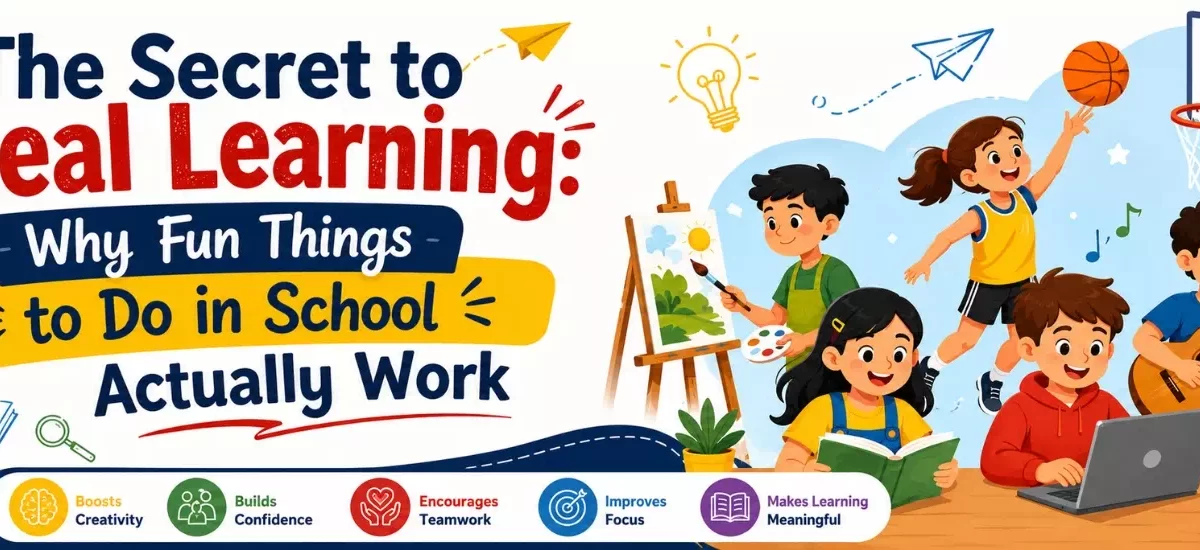
Have you ever watched a student’s eyes glaze over while a teacher recites facts from a dusty chalkboard? It is a quiet tragedy that happens in thousands of classrooms every single day. Most schools treat the brain like a bucket that needs filling rather than a fire that needs ignition. At The TonsBridge School, we realized long ago that the traditional lecture model is failing the modern child. Our 18-acre campus in the heart of Dehradun serves as a laboratory for a different kind of energy. We believe that fun things to do in school are the actual catalysts for deep, permanent learning. If a child is not leaning forward in their seat, the lesson has already been lost.
- The Physics of Engagement: Why “Fun” is Non-Negotiable
- High-Stakes Logic: Classroom Games for High Schoolers
- Tactical Play: Fun Things to Do in the Classroom for Middle School
- Beyond the Four Walls: Outdoor School Activity
- The Creative Buffer: School Activity Clubs
- The Verdict: Why It Works
- Frequently Asked Questions
The Physics of Engagement: Why "Fun" is Non-Negotiable
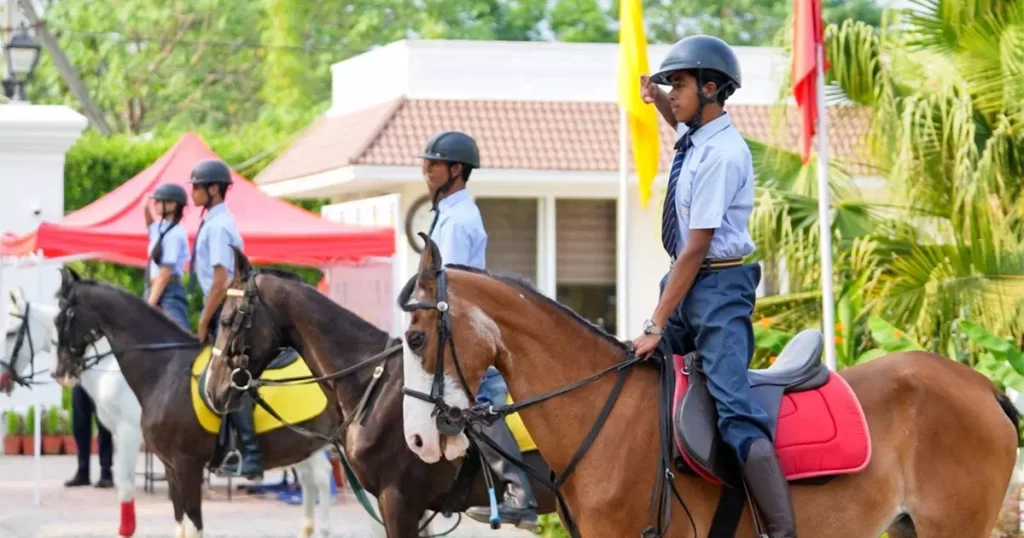

Cognitive retention depends entirely on attention. When you introduce Fun Activities for Students, you aren’t just entertaining them: you are lowering their affective filter. In a high-pressure academic environment, stress blocks the brain’s ability to process new data. By using interactive learning activities for students, we create a biological window where the mind is most receptive.
Boredom leads to neural pruning. On the other hand, school activities that spark genuine curiosity lead to long-term memory formation. At TonsBridge, the goal is to ensure that a school activity is indistinguishable from the learning objective itself.
High-Stakes Logic: Classroom Games for High Schoolers
High schoolers are the ultimate skeptics. They can smell a patronizing “ice-breaker” from a mile away. They require classroom games for high schoolers that challenge their ego and their intellect simultaneously.
- The Global Crisis Simulation: In our senior humanities and commerce wings, the desk isn’t just a place to sit. It becomes a station in a war room. Students are assigned roles: a finance minister, a diplomat, or a CEO. They must navigate a real-time economic or political crisis using the technical data from their syllabus. This is an engaging activity in classroom settings because it turns an abstract theory into a survival tactic.

- Silent Debates: To make sure that every student’s voice is heard, we use large-scale gallery walks. Students move through the room in complete silence, jotting their arguments down on massive sheets of paper. This school activity infuses precision in writing and deep reflection, proving that fun things to do in the classroom don’t always have to be loud.
- The Stock Market Sprint: Students handle virtual investment portfolios using live data. It’s not just studying market trends; it’s experiencing the thrill of trading. This classroom game turns the challenging world of math and economics into an exciting race.
Tactical Play: Fun Things to Do in the Classroom for Middle School
The transition from primary to secondary school is where most students lose their spark. We prevent this by ensuring fun things to do in the classroom are anchored in sensory realism.
- Human Anatomy Scavenger Hunt: In our state-of-the-art biology labs, students don’t just label diagrams. They are given a list of “symptoms” and must find the corresponding organ on our medical-grade models to “save” the patient. This turns educational activities for students into a race against the clock.
- Math Relays: We divide the class into teams. Each student must solve one specific line of a complex algebraic proof before tagging their partner. It combines physical movement with mental agility. It is a school activity that proves speed and accuracy can coexist.
- Linguistic Auctions: Students play “linguistic auctions,” in which they bid on sentences within an assigned point limit. The students need to spot grammatical mistakes to secure the bid. Such games make learning fun for the students.
Beyond the Four Walls: Outdoor School Activity
Dehradun is our greatest lab. The geography of the Doon Valley, bordered by the Tons and Nemi rivers, allows for School Activities that simply cannot happen in a city center.
- The Topographic Trek: Geography isn’t a map; it is a hike. Students take clinometers and surveying tools into the Shivalik foothills to measure gradients. When you calculate the slope of a hill you just climbed, the geometry sticks forever.
- Soil Chemistry Trials: Our educational activities for students often move to the school’s green zones. Students collect samples and test for pH levels, linking their chemistry syllabus to the literal ground beneath their feet.
The Creative Buffer: School Activity Clubs
The TonsBridge School hosts an array of specialized clubs that act as the final pillar of our engagement strategy.
- The Inquisitive Club: This is for the student who asks “why” too many times. It is a space for high-level trivia and deep-dive research into fringe science and history.
- The Artisan Club: Here, the school activity focuses on the tactile. From pottery to digital design, it is about the “joy of the make.”
- The Robotics and Coding Lab: This isn’t a computer class. It is a workshop where students build and program machines to solve specific navigational challenges. This is the definition of a fun activity to do in class that has zero “marketing fluff.”
The Verdict: Why It Works
Why do we insist on this level of school activity integration? Because the professional world doesn’t care what you can repeat: it cares what you can solve.
Interactive learning activities for students build a toolkit of soft skills: negotiation, leadership, and emotional resilience. When a child fails at a classroom game, they learn to troubleshoot. When they succeed, they learn to lead.
So, what is the outcome? You get a student who doesn’t just pass the exam but masters the concept. Whether it is through engaging activity in classroom settings or outdoor education activities, The TonsBridge School ensures that the curiosity of a child is never sacrificed for the rigor of the board. We don’t just provide fun activities for students to fill time. We provide them to give that time value.
Take a walk through our labs or our playgrounds. You won’t see passive observers. You will see active participants. That is the TonsBridge difference. It is a commitment to ensuring that every school activity is a stepping stone toward a more competent, curious, and confident adult. After all, the best fun things to do in school are the ones that prepare you for the world outside of it.
Frequently Asked Questions
1. Can fun things to do in school actually improve board exam results?
Yes. Cognitive science proves that active participation strengthens neural pathways far better than passive listening. When students apply a math formula during a high-energy relay, the information moves into long-term memory. This makes recall during high-pressure exams much more reliable.
2. How do you maintain discipline during high-energy school activities?
Discipline comes from engagement rather than silence. We use a method of “structured chaos” where every game has strict rules and clear academic objectives. Students remain focused because they are invested in the outcome of the activity.
3. Are classroom games for high schoolers too childish for teenagers?
Not if they are designed with maturity in mind. We avoid simple play and focus on complex simulations, such as mock stock markets or diplomatic war rooms. These activities respect their intelligence and social dynamics while making the syllabus tangible.
4. Why does an outdoor school activity help with science and geography?
Physical geography is best understood through sensory experience. Measuring the gradient of a hill or testing soil pH in the valley turns abstract textbook diagrams into real-world data. It removes the “marketing fluff” from education and replaces it with hard, scientific inquiry.
5. How often should interactive learning activities for students be conducted?
They should be a daily occurrence. We don’t view these as a “break” from the curriculum but as the delivery system for it. Mixing short, punchy activities with deep-dive sessions keeps the cognitive load balanced and prevents mental fatigue.